by Sean | Mar 21, 2016 | Building Green, Energy Efficiencies, Energy Efficient, Postings
Submitted by Sean D Sullivan, President, Living Stone Construction Inc.
Few things in life can be as exciting — and equally daunting — as building a new house. Throughout the design and construction process, there are multitudes of decisions to consider that will affect the final cost.
“Final cost.” It’s a phrase we associate with the sum total of all the labor and material costs that go into building a new house. But in reality, the final cost of your new house will continues to tally up long after you move in. Perhaps we should think of it as your home’s ongoing cost.
Of course there will be maintenance, taxes, neighborhood association fees and the like, but the main contributor to your home’s ongoing cost will be its consumption of energy. With that in mind, here are six practical ways to help minimize the future ongoing costs of your new house before it’s even built.
1. Choose High-Performance Windows and Solar Screens
One of the most effective ways to cut your home’s energy consumption is to install high-performance windows. Be sure to select windows with spectrally selective glazing or qualified films that “bounce
Read More
by Sean | Mar 23, 2015 | Energy Efficiencies, Energy Efficient
Geothermal heat pumps (GHPs), sometimes referred to as GeoExchange, earth-coupled, ground-source, or water-source heat pumps, have been in use since the late 1940s. They use the constant temperature of the earth as the exchange medium instead of the outside air temperature. This allows the system to reach fairly high efficiencies (300% to 600%) on the coldest winter nights, compared to 175% to 250% for air-source heat pumps on cool days.
Although many parts of the country experience seasonal temperature extremes — from scorching heat in the summer to sub-zero cold in the winter—a few feet below the earth’s surface the ground remains at a relatively constant temperature. Depending on latitude, ground temperatures range from 45°F (7°C) to 75°F (21°C). Like a cave, this ground temperature is warmer than the air above it during the winter and cooler than the air in the summer. The GHP takes advantage of this by exchanging heat with the earth through a ground heat exchanger.
Read More
by Sean | Sep 17, 2014 | Accreditation, Building Green, Green Building, Quality, Recognition
BY KATE O’CONNOR
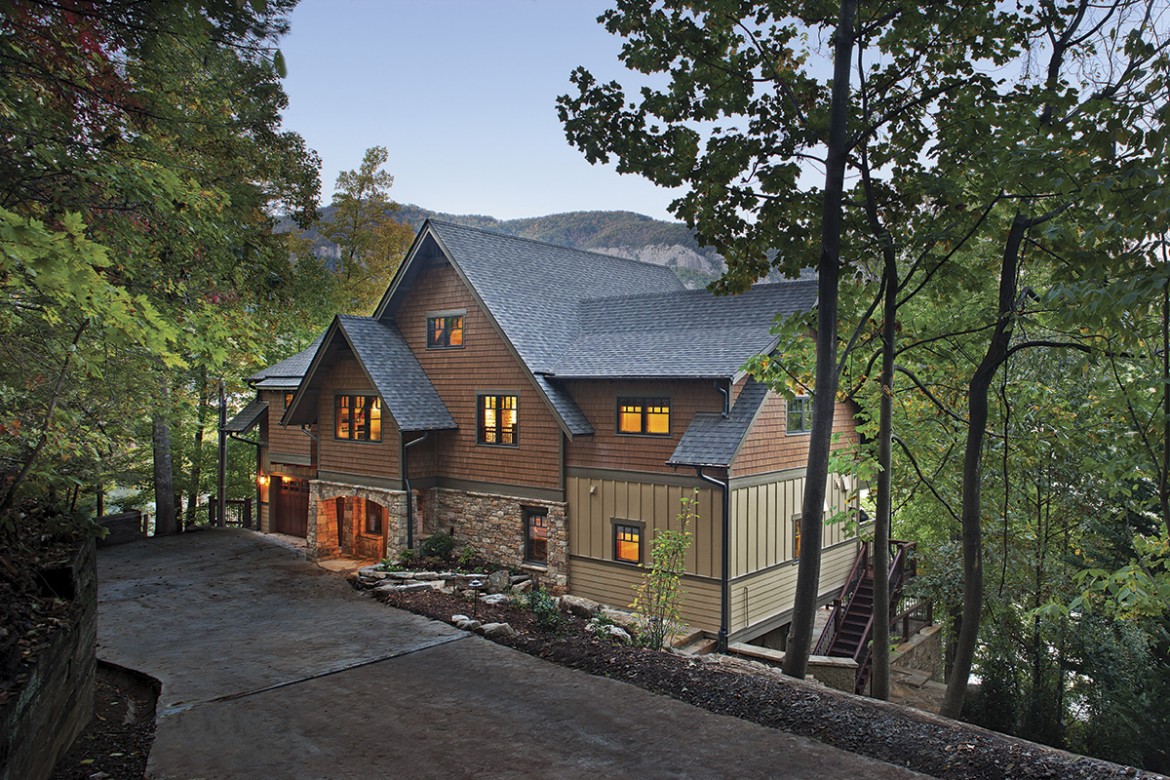
Designed by architect Maury Hurt to occupy the footprint of an existing A-frame, this serene lakeside home maximizes its location and boasts many vernacular exterior finishes including stone, cedar shake and pebble dash stucco. Green built and Energy Star efficient, the home earned regional and national awards for the builder, Living Stone Construction, and a state-level award for the interior designers, Allard & Roberts.
Photography by David Dietrich
Adiscreet sign at the front entrance reads “Sanctuary.” Fair enough. You’ve navigated some narrow country roads and come down a steep driveway to get here. The cedar shake and stone house is tucked into a wooded lot, perched on the hillside beside Lake Lure. A mountain retreat — a lake house…it makes sense. But then you walk through the stone portal and enter the great room. Before you, a massive arched wall of windows captures a stunning view: the vast sky, the distant, craggy face of a mountain and the sparkling waters of the lake.
Read More